ledgerkeep
Ledgerkeep
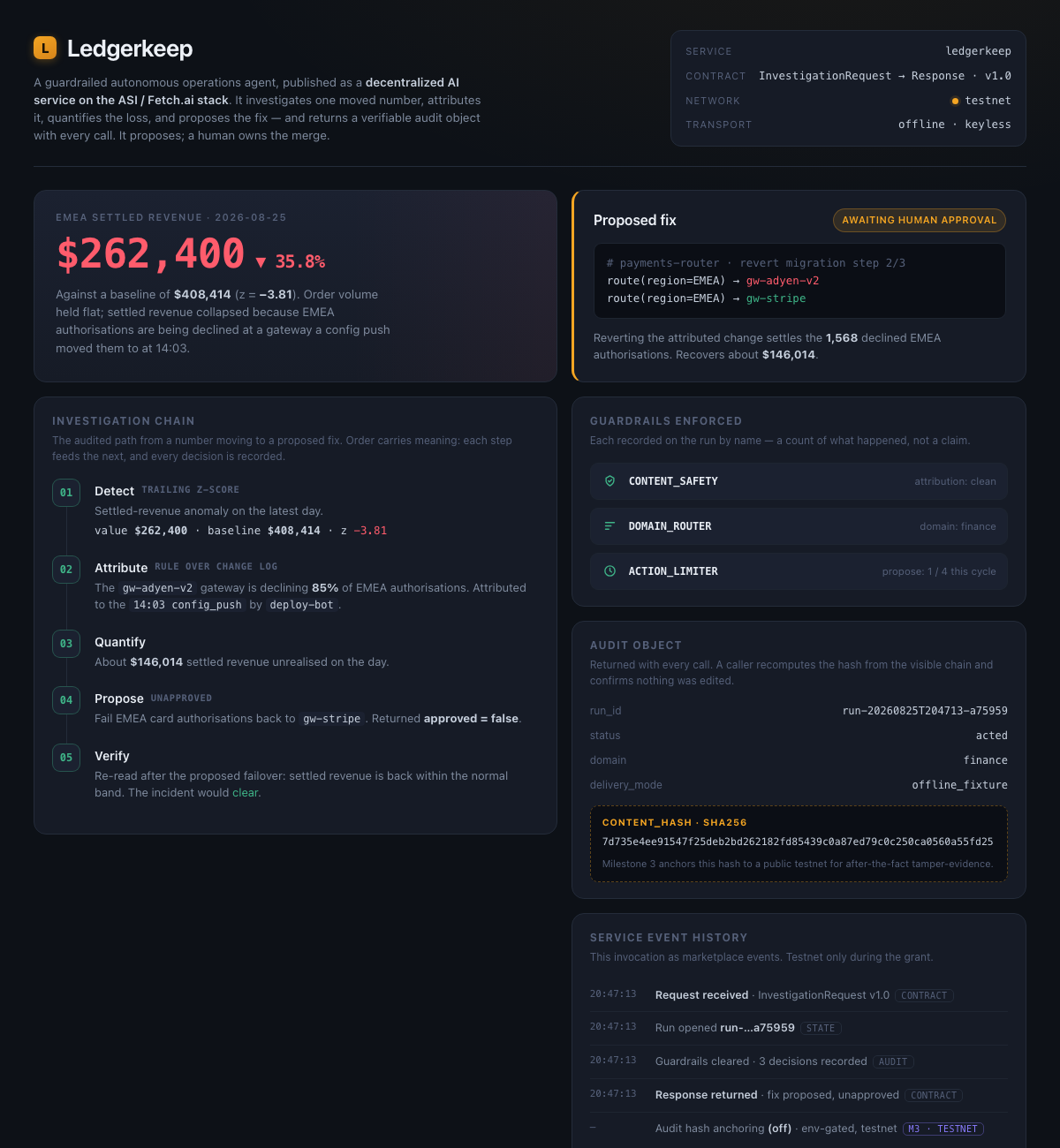
A guardrailed autonomous operations agent, published as a decentralized AI service on the ASI / Fetch.ai stack. It detects a settled-revenue drop, attributes it to the exact configuration change that caused it, quantifies the loss, and proposes the one-line fix, returning a verifiable audit object with every call. It proposes; a human owns the merge.
Every call answers one typed contract over either transport: a real uAgents endpoint on Agentverse when a seed phrase and the SDK are present (testnet only), or an in-process transport otherwise, so the service runs keyless. The safety layer is not a promise for a later milestone; it is vendored, tested here, and recorded by name on every run.
Milestone 1 of the Ledgerkeep grant proposal: the re-themed service, the documented contract, the audit object on every call, and the offline loop and guardrail suite running green. Testnet only, never mainnet.
▶ Live demo · Watch the walkthrough · Paper (PDF) · Deck (PDF) · Built for the ASI Alliance
Read docs/LIMITATIONS.md first for the short version of what has run, what is simulated, and what is not built. Nothing on this page contradicts it.
The 30-second demo
$ python -m ledgerkeep

Ledgerkeep - guardrailed autonomous operations agent
      ASI / Fetch.ai service - transport=offline - offline_fixture - run run-...

[1/5] Detect     settled_revenue on 2026-08-25
      value $262,400 vs baseline $408,414  z=-3.81  -35.8%
[2/5] Attribute  EMEA settled revenue collapsed because gw-adyen-v2 is declining
      85% of EMEA authorisations. Attributed to the 14:03 config_push by deploy-bot.
[3/5] Quantify   EMEA settled revenue is 36% below baseline: about $146,014 unsettled.
[4/5] Propose    Fail EMEA card authorisations back to gw-stripe  (unapproved)
[5/5] Verify     Re-read after the proposed failover: the incident would clear.

guardrails enforced  ACTION_LIMITER, CONTENT_SAFETY, DOMAIN_ROUTER (3 decisions recorded)
audit content_hash   7d735e4ee91547f25deb2bd262182fd85439c0a87ed79c0c250ca0560a55fd25
Step 4 is the one worth pausing on. The proposed fix is never applied: it comes
back with approved=False every time, so an autonomous run ends at a proposal a
human still has to merge. The step before it is the other one to notice: the
attribution is screened by CONTENT_SAFETY before anything downstream trusts it,
so a poisoned diagnosis quarantines the run with no proposed fix at all.
The same guarantees are enforced in the tested path, and pytest proves each of
them.
Architecture
flowchart TD
    Caller["Caller<br/>(operator / another ASI agent)"] -->|InvestigationRequest| MP

    subgraph MP["MarketplaceService (ASI / Fetch.ai adapter)"]
      direction TB
      T1["uAgents on Agentverse<br/>(seed + SDK, testnet)"]
      T2["offline transport<br/>(keyless, default)"]
    end

    MP -->|one contract, either transport| SVC

    subgraph SVC["run_service — the guardrailed loop"]
      direction TB
      D["1 Detect<br/>trailing z-score"] --> A["2 Attribute<br/>rule over change log"]
      A --> CS{"CONTENT_SAFETY<br/>screen"}
      CS -->|flagged| Q["quarantine<br/>no fix"]
      CS -->|clean| R["3 Route<br/>domain classifier"]
      R --> QN["4 Quantify"]
      QN --> AL{"ACTION_LIMITER"}
      AL -->|allowed| P["5 Propose<br/>approved = false"]
      P --> V["Verify<br/>re-read metric"]
    end

    SVC -->|"InvestigationResponse<br/>+ AuditObject (content_hash)"| Caller

    subgraph CORE["vendored agent_core control plane"]
      G["guardrails"]:::c
      RT["domain router"]:::c
      ST["durable run state"]:::c
      MC["MCP bridge"]:::c
    end
    SVC -.uses.-> CORE

    classDef c fill:#1b1a30,stroke:#2f2657,color:#cfc6f0;
Run it
Everything runs with the standard library plus python-dotenv. No credentials, no
cloud project, no network.
python -m ledgerkeep            # narrate one guardrailed investigation
python -m ledgerkeep --json     # the full InvestigationResponse as JSON
python -m ledgerkeep --describe # the marketplace manifest a caller discovers
Call the service contract directly:
from ledgerkeep.marketplace import MarketplaceService

service = MarketplaceService()
response = service.invoke({"metric": "settled_revenue"})
print(response.status)                     # "acted"
print(response.proposed_fix.approved)      # False, a human owns the merge
print(response.audit.content_hash)         # sha256 over the decision chain
The service contract
InvestigationRequest: typed, all-defaults, so the simplest call isInvestigationRequest(). Fields:metric,z_threshold,note,request_id,contract_version.InvestigationResponse: the typed reply.anomaly,attribution,impact,proposed_fix(alwaysapproved=False),verification,delivery_mode(offline_fixture|live, so a stub is never mistaken for a live figure), and a mandatoryaudit.AuditObject: returned on every call. Carries the run id, the ordered guardrail decisions by name, the classified domain, the recurrence record, and a sha256content_hashover the decision chain. A response without an audit object is not a valid response.
The guardrails
Autonomy is only safe when it is bounded. Every decision is recorded on the run by name, so a claim of enforcement is a count of what happened.
| Guardrail | What it does | Tested by |
|---|---|---|
CONTENT_SAFETY |
Screens the attribution before anything trusts it; a poisoned diagnosis quarantines the run with no proposed fix | test_content_safety_quarantines_a_poisoned_attribution |
ACTION_LIMITER |
Rate-caps the proposal; a zero-cycle cap blocks it and records the block | test_action_limiter_blocks_the_proposal_when_the_cycle_cap_is_zero |
DOMAIN_ROUTER |
Classifies the incident domain for the audit trail | test_every_response_carries_a_full_audit_object |
Built on agent-core
The control plane is the vendored agent_core package:
guardrails, a domain-aware router, durable run state with recurrence detection, and
an MCP bridge. It is vendored into this repo and exercised by its own tests here,
so the safety layer is not a promise for a later milestone.
Tests
PYTHONPATH=. pytest -q, 82 Python tests. No env vars or credentials needed; the suite cuts the socket, HTTP and subprocess layers before import and forces the run store in-memory. Service contract (10), guardrailed loop (7), marketplace adapter (10), fixture ledger (7), vendoredagent_core(48).
Every defence in this repo has a test that fails without it.
Built for the ASI Alliance and Deep Funding
Ledgerkeep is a candidate entry to Deep Funding, the grant programme of the Artificial Superintelligence Alliance (the Fetch.ai, SingularityNET, and Ocean Protocol federation). It is an application, not an accepted or funded grant: there is no partnership with the Alliance and no endorsement, and nothing here should be read as one.
The reason it belongs on the ASI stack rather than a closed SaaS is that Deep
Funding backs decentralized AI services: agents others can discover, call, and
pay for while the builder keeps ownership. An operations agent a team must trust is
exactly that shape. The funder’s technology is load-bearing behind an adapter seam:
when a seed phrase and the uagents SDK are
present, the service is a real uAgents endpoint on
Agentverse (testnet only); otherwise it answers
the identical contract keyless. The milestone roadmap integrates the ecosystem
where it is needed: MCP composition so another ASI agent can call Ledgerkeep as a
tool (milestone 2), testnet audit-hash anchoring for verifiable provenance
(milestone 3), and Agentverse / marketplace publication (milestone 4). Everything
in this repo is testnet only, with no mainnet deployment and no real funds.
The full milestone-mapped write-up is in docs/PROPOSAL.md.
Paper, deck & UI
- Paper (PDF):
paper/paper.tex, a short technical write-up (rebuild:tectonic paper/paper.tex). - Deck (PDF):
deck/deck.md, a Marp slide deck (rebuild:marp deck/deck.md --pdf). - Live demo:
ui/index.html, the interactive incident console (also opens offline overfile://). It is a browser simulation and says so on the page; every figure it shows is read off the audit object the service returns, with no invented transaction hashes. - Walkthrough video:
docs/ledgerkeep-demo.mp4, a narrated tour of the 03:00 problem, the guardrails, the service contract, and the grant roadmap (also on YouTube). - Demo script:
DEMO.md, the recording kit.
Cite
@software{sarkar_ledgerkeep_2026,
  author  = {Dipankar Sarkar},
  title   = {Ledgerkeep: A Guardrailed Autonomous Operations Agent as a Decentralized AI Service},
  year    = {2026},
  version = {0.1.0},
  url     = {https://github.com/doom2quake/ledgerkeep},
  license = {MIT}
}
License
MIT, held by doom2quake, see LICENSE.